
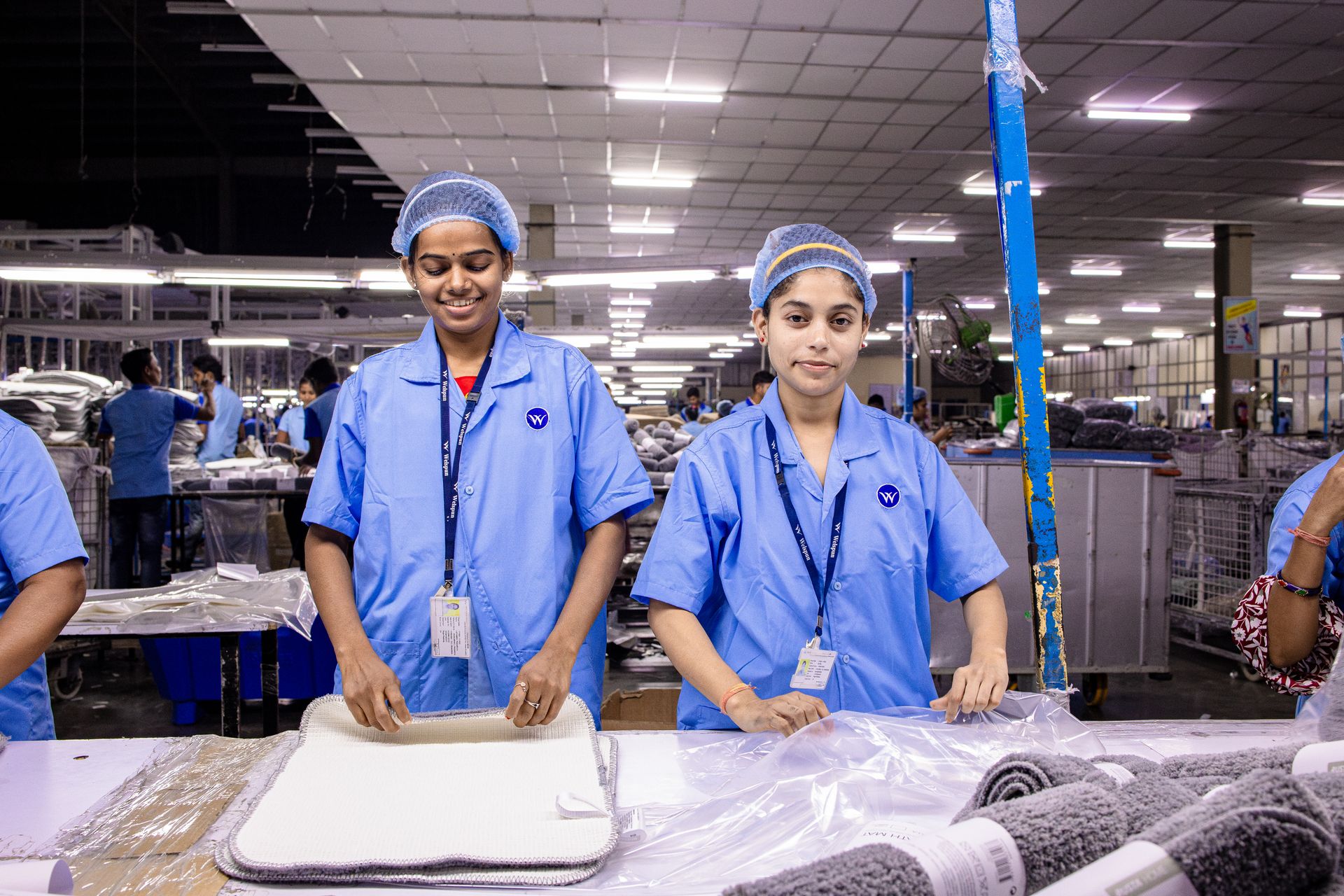
INDUSTRIES → MANUFACTURING & INDUSTRY 4.0
The Human Layer of Industry 4.0.
Manufacturing & Industry 4.0 automates tasks, not people. DISHA connects your plant and corporate workforce to Workforce Intelligence — automation readiness, robotics deployment, MES rollouts and plant expansion planned around capability, continuity and dignity.
How does the workforce transform as factories become intelligent — without losing the judgment that keeps lines running?
Pain-Point → DISHA Solution Map
Select a pain point: root cause, DISHA intervention, workflow, data inputs and the measurable outcome open beneath.
Root cause
Task-level automation impact hidden inside job titles
DISHA intervention
Skills Forecasting + Workforce Planning + Scenario Planning
How it works
Task analysis → automation exposure → reskill/redeploy/hire mix
Data inputs
Process/task data, role profiles
Measurable outcome
Automation programs land with a workforce plan attached (illustrative)
Industry Methodology
Safety and continuity first: the methodology treats certification currency and knowledge continuity as first-class citizens.
The universal loop — the same in every industry
The universal loop — on the plant floor and in the corporate office.
Intelligent Factory Workforce Simulator
Select the Industry-4.0 program, set the shift assumption — task change, role change, skill demand, readiness and the train/redeploy/hire mix re-compute.
Industry-4.0 program
Workforce outlook — Automated line
Task change
Manual load/inspect tasks → cell monitoring and exception response
Role change
Line operators become cell operators + floater pool
Skill demand
Cell operation · SPC basics · exception triage
Readiness (illustrative)
58%
Intervention mix
Deploy: train 60% of line crew in 2 waves; measure: first-pass quality + stoppage time
Illustrative scenario — synthetic data. Automation changes tasks, not people: every plan keeps humans employed, trained and governed.

WHY DISHA HERE
Automation Programs Land With a Workforce Plan Attached
DISHA's value in Manufacturing is the train/redeploy/hire mix behind every robot cell and MES rollout — automation changes tasks while people are trained, redeployed and governed, with safety-critical certifications always human and audited.
See Workforce ReskillingIntegration With Your Operations Stack
Workforce data connects to operations reality without touching OT security boundaries.
Existing systems (source of record)
DISHA intelligence fabric (people capability)
Supervisors and operators (the judgment layer)
Adoption Options
Start with one plant or one critical trade; scale across the network as governance matures.
Overlay mode
Reads HR/WFM/training systems; zero OT impact
Embedded
Readiness inside supervisor tooling
Module-by-module
Credentialing or risk first
Intelligence layer
Cross-plant people-capability connection
Full platform
The complete Human Capital Operating System
Role-Based Value
COO / Plant directors
Decision: Line continuity with automation programs
Data: Dependency, certification, readiness
DISHA: Risk + Planning + Credentialing
Outcome: Fewer unplanned stoppages (illustrative)
Maintenance heads
Decision: Diagnostics expertise survives retirements
Data: Dependency maps, succession
DISHA: Workforce Risk + knowledge transfer
Outcome: Critical knowledge stays in the plant
HR / People leaders
Decision: Redeploy through automation waves
Data: Adjacent capability, move plans
DISHA: Mobility + Pathways
Outcome: Automation with redeployment, not exits
Corporate engineering
Decision: Network-wide capability consistency
Data: Cross-site analytics
DISHA: Analytics + standardized learning
Outcome: Every plant audit-ready (illustrative)
Ops excellence leads
Decision: MES/automation rollouts with people plans
Data: Task change analysis
DISHA: Forecasting + Scenarios
Outcome: Rollouts land with trained crews
Tangible Business Outcomes & Measurement
Measured with baselines, targets, periods, sources, owners and interventions. Illustrative figures are placeholders for your data.
| KPI | Baseline → Target (illustrative) | Period · Source · Owner |
|---|---|---|
| Safety-critical certification lapses | 9 → 0 per period (illustrative) | Quarterly · Training system · Owner: Plant safety |
| Automation-affected roles with completed workforce plans | 12% → 90% (illustrative) | Per program · HRIS · Owner: COO office |
| Maintenance regrettable attrition | 13% → 8% (illustrative) | Trailing year · HRIS · Owner: HR |
| Cross-plant internal mobility | 18 → 60 moves/year (illustrative) | Rolling year · Mobility records · Owner: Network HR |
Illustrative scenario — real figures come from your connected, validated data.

THE HUMAN LAYER
Industry 4.0 Still Runs on Judgment Call
Sensors catch what they can see. People catch what sensors miss. Manufacturing workforce intelligence keeps the humans behind the machines ready, mobile and continuously trained — automation changes tasks, it does not erase people.
AI & Agent Architecture
Industry intelligence agent
Industrial labor-market and automation trends
Inputs: Licensed market data
Outlook briefs · Human: ops leadership reviews
Workforce analyst agent
Plant population and capability analytics
Inputs: HRIS/WFM/training
Insight packs · Human: plant HR validates
Skills & capability agent
Trade capability, certification currency
Inputs: Training records, assessments
Capability maps · Human: supervisor + employee confirm
Readiness agent
Automation and MES readiness per role
Inputs: Task models, capability
Readiness maps · Human: ops decides
Continuity agent
Maintenance dependency scenarios
Inputs: Dependency maps, demographics
Continuity options · Human: plant leadership acts
Workflow agent
Train/redeploy/hire orchestration
Inputs: Plans, openings
Orchestrated programs · Human: approvers act
Governance agent
Audit trails; safety-governance enforcement
Inputs: Logs, policies
Compliance trail · Human: governance sign-off
Governance, Privacy & Responsible AI
CONCEPT FILM
Automation Changes Tasks. People Build the Future — Manufacturing
90–120s · reserved film slot
Automate tasks. Grow people.
Where This Connects
Canonical pillars — the concepts beneath
Solutions most used in this industry
Keep exploring
Hiring technicians and engineers? The Employers marketplace publishes roles with verified skill profiles. →Related industries
- Technology & IT →
- Banking, Financial Services & Insurance →
- Healthcare & Life Sciences →
- Education & EdTech →
- Automotive & EV →
- Energy & Utilities →
- Infrastructure & Construction →
- Retail & E-commerce →
- Telecommunications →
- Logistics & Supply Chain →
- Government & Public Sector →
- Professional & Business Services →
- Hospitality, Travel & Tourism →
- Global Workforce, Staffing & Mobility →
- Aerospace →
- Defense →
- Mining →
- Agriculture →
- Maritime →
- Semiconductors →
- Pharmaceuticals →
- NGOs →
- Gig Economy →
- Research →
Research & Resources
External references for context — attributed to their sources.
Build the Workforce Behind Industry 4.0
Automation readiness, continuity and human growth — connected across your plants.